
Service area

Roofing in Indio.

The valley’s oldest incorporated city and its largest, sitting below sea level — and one of the communities Riverside County names inside a special wind region.

Illustrative view across rows of tile-roofed tract homes on the flat valley floor, a date palm grove and distant mountains beyond
Indio, illustrated. Not a photograph of our work.
The whole service area, with Indio marked. The pins are city centres. No job, photograph or date is marked on this map.

Mid-valley, either side of Interstate 10. City Hall stands fourteen feet below sea level.

Elevation
14 ft below sea level
Incorporated
May 16, 1930
Population
89,137 2020 census
Area
33.24 sq mi
ZIP codes
92201, 92203
Energy code
California climate zone 15

Elevation, incorporation, census and area are public record. The climate zone is read from the California Energy Commission's own list of building climate zones by ZIP code.

Conditions

Roof exposure in Indio.

  • 01

    Sustained summer heat

    Summer highs run above 108 °F, while annual rainfall is under 4 inches in the cited climate record. Repeated heating and cooling stresses roof materials, joints and flashings; UV exposure wears protective surfaces. Long dry periods do not establish that a roof is watertight. The inspection needs to consider both ongoing heat exposure and the details that will carry water during a storm.

  • 02

    A special wind region, on the county’s own list

    Riverside County Building & Safety names Indio in the special wind region list in its July 2021 design-load handout. That document cites 130 mph for Risk Categories I and II at Exposure C, versus 100 mph outside the region. The comparison illustrates why fastening and edge details matter. Confirm current site-specific wind design criteria with the building department rather than using a historical handout as the project specification.

  • 03

    The far end of the blowsand corridor

    The USGS describes wind-blown sand moving east from the San Gorgonio Pass toward Indio, with the most active period from April through June. Abrasion and deposited sand are relevant to exposed roof surfaces and drainage. Look for coating wear, shingle surface deterioration and sediment near outlets. Those observations should be assessed alongside age, installation condition and other causes of damage.

  • 04

    Monsoon, July to September

    Summer thunderstorms can bring intense rainfall, gusts and blowing dust to a city below sea level. Roof drainage needs clear outlets and connected flashing details, even after a long dry period. An assessment should include low spots, scuppers, downspouts and evidence of prior water entry. A roof that has not leaked in recent dry weather can still have defects that become apparent during a storm.

The roofs here

The roof assemblies behind Indio’s buildings.

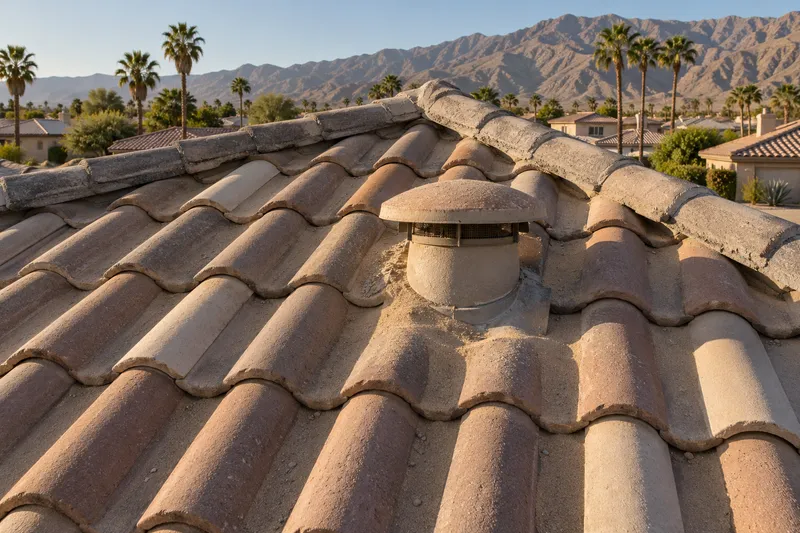
Illustrative close view up a weathered concrete S-tile roof, wind-blown sand in the pans and around a roof vent, palms and mountains beyond
Illustration of the roofs described here, not a job of ours.

Tile roofs from the tract-building years

Indio expanded through the 1980s, 1990s and 2000s as residential tracts replaced farmland. Homes from those periods may have original roofing, replaced underlayment or several generations of repairs. On a tile roof, intact surface tile does not establish the condition beneath it. An inspection should check the underlayment, flashing and repair history before recommending another localized repair or a replacement.

Older housing around downtown

Indio incorporated in 1930. Housing near the downtown grid can predate the later tract neighborhoods, with roof alterations and materials that differ from newer development. Establish the existing layers and decking condition rather than assuming the visible covering tells the full history. If removal exposes damage, identify the required deck repairs before covering the assembly again.

Low-slope along Highway 111

Commercial properties along Highway 111 often have low-slope roofing with rooftop equipment. Drainage, HVAC curbs, vents and perimeter flashing are inspection priorities alongside the open roof surface. A coating proposal should account for those transitions, access for equipment service and the condition of the existing assembly. Scheduling also needs to reflect how the owner and tenants use the building.

Local building patterns help guide an inspection. Your roof’s actual condition, materials and repair history determine the recommendation.

Code and permits

Roofing codes and permits in Indio.

Confirm the requirements for the building and proposed roof assembly. The links below go directly to the relevant authorities.

Climate zone 15

Both 92201 and 92203 fall in California building climate zone 15. Climate zone, building type and roof slope help determine the energy requirements for a proposed roof. California’s climate-zone rules do not apply to our Arizona service region.

The CEC's climate zone list

Cool roof requirements

California’s 2025 Energy Code took effect January 1, 2026. Cool-roof requirements vary by building type, climate zone, roof slope and project scope. Check the applicable path and the product’s CRRC rating before choosing a roof surface.

A single reflectance or SRI threshold does not apply to every roof. Confirm the current requirements and any exceptions with the building department.

Title 24 at the Cool Roof Rating Council

Wind

Riverside County Building & Safety names Indio among the communities lying inside an ASCE 7 special wind region in its July 2021 handout. That document puts the gust there at 130 mph for Risk Category II, Exposure C, against 100 mph in the parts of the county that are not. Wind load rises with the square of the speed, so that is about 69 per cent more load — carried by the fastenings, the perimeter and the edge metal.

The county's design load handout (PDF)

The county wind handout cited here is revision 07/2021, based on the 2019 California Building Code and ASCE 7-16. Its figures explain the cited document; they are not a current site-specific design calculation. Confirm the governing code edition and design criteria with the building department.

What we do

Roofing services in Indio.

Assess tile underlayment and flashing on established homes, and drainage and equipment details on commercial roofs. Compare repair and replacement from the inspection findings.

Additional roofing services for homes and commercial properties:

Free written estimate

Know what your
roof needs.

Free written estimate. No obligation.

Prefer to talk? Call us.

(442) 637-5222

Coachella Valley, California & Greater Phoenix, Arizona.
A 50-mile Phoenix radius, including Buckeye.

Add roof details (optional)

Your details prepare an email request for you to send. Nothing is sent automatically.

License & written terms

Verify California CSLB #1155461

Ask for insurance documentation and applicable warranty and maintenance options in writing before work begins.